About
Who I am, and why this work.
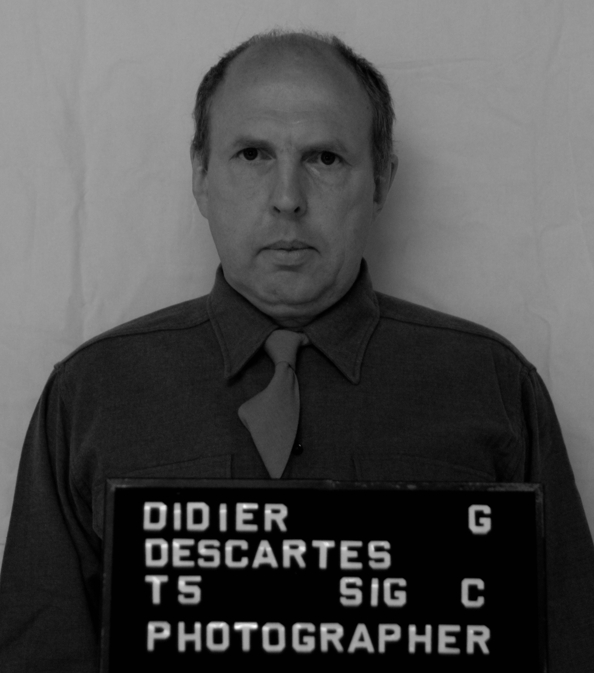
Who I am
My name is Didier Descartes. I spent my entire career in IT; photography and living history remain a personal commitment, not a commercial activity.
This interest runs deep. My maternal grandfather was a train driver and a member of the Resistance; wanted by the German authorities, he had to flee Liège with his family, including my mother. Between September 1989 and 8 May 1995, Belgian television (RTBF) broadcast "Jours de guerre" ("Days of War"), a monthly programme presented by Jean-Jacques Jespers that traced, day by day, the 2,194 days of the war, military events, resistance, occupation, daily life, through more than 700 testimonies. That programme, together with my family's own stories, fed my interest in this period, and in what period images allow us to understand about the witnesses who lived through it.
It was in 2008, at the commemoration of the American army's entry into Belgium at the hamlet of Cendron, in the village of Forge-Philippe near Chimay, that I began photographing and following living history re-enactments, at almost the same spot where the American 2nd Infantry Division crossed the Belgian border on 2 September 1944.
Why film
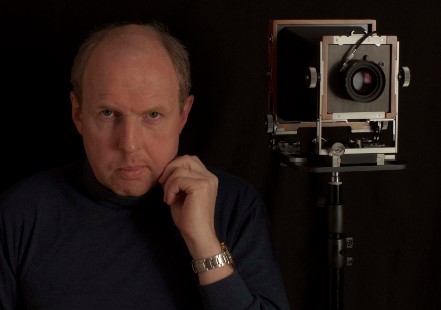
I did not choose film photography out of nostalgia. I chose it because it forces me to slow down: preparing each image before pressing the shutter, then developing and printing every negative myself in the darkroom. This relationship with time connects directly to what I photograph, a memory that men and women keep alive, with the same rigour, every year, in the field.
A silver gelatin negative is also a physical object, not a file. It can be preserved, archived, passed on to an institution decades after it was made, exactly like the objects and testimonies these associations keep alive.
An inspiration: Tony Vaccaro
Among the photographers who feed this work, one name matters more than the others: Tony Vaccaro. An American soldier who landed in Normandy, he documented the liberation of Europe with a simple Argus C3 camera, sometimes developing his negatives inside his helmet for lack of anything better. His work is a reminder that a photographic testimony does not depend on the sophistication of the equipment, but on being present in the field, in the right place, at the right time, a conviction that guides my own practice directly.
In the field
I work on film, without a motor drive or intrusive flash: I fit into re-enactments and commemorations without disrupting them, and I take the time to observe before photographing. I travel across Wallonia, Brussels, and the northern half of France, and I am now looking to extend this work to First World War sites.
Background
Self-taught, I learned my craft in the field, complemented by training at Studio Harcourt in Paris around 2010-2011, the portrait house known since the 1930s for its work on light and black and white.